Anthropic launches Claude Opus 5.5: matching Fable 5.1 reasoning with 40% lower running costs
Anthropic released Claude Opus 5.5 on September 22, 2026, as the first model in the Claude 5.5 family. It features a 1M token context window, Fable 5.1 grade reasoning for agentic coding, and 40% lower operational costs.
OpenAI launches GPT-6 Sol and GPT-6 Luna: targeting agentic workflows and high-volume tasks with 50% lower API pricing
On September 22, 2026, OpenAI introduced GPT-6 Sol and Luna to expand its GPT-6 lineup. Sol targets complex agentic workflows and coding, while Luna handles high-volume tasks with 50% lower API pricing.
Meta One Launches: Unified Subscription for Facebook, Instagram, WhatsApp and Meta AI
Meta officially rolled out Meta One in September 2026, bundling premium features across Facebook, Instagram, WhatsApp, and Meta AI from Core to Max tiers.

RIKEE: Real-Time AI Phone Calls, Multi-Persona Practice, and Full JLPT Preparation
RIKEE combines real-time AI phone calls, 10+ realistic personas across romance and career scenarios, an 89-course 718-lesson curriculum, auto-generated study notes, and JLPT N1-N5 mock exams with native audio explanations.

AI agents are flooding public services: study identifies 84 potential cases across 11 jurisdictions
A study reported by TechCrunch catalogs 84 potential cases of AI agents generating high-volume public-service requests across 11 jurisdictions, while stressing that most causal links remain unproven.

OpenAI pauses new ChatGPT Pro signups as Astra demand surges; existing users are unaffected
OpenAI has paused new signups for its $200-per-month ChatGPT Pro plan because of Astra-related demand; existing Pro, API, Go and Plus access is unaffected.
Google launches Gemini for Windows with Alt+Space access and Workspace integration
Google is rolling out the Gemini desktop app globally for Windows 10 and 11, with Alt+Space access, Workspace context and Nano Banana image generation.
OpenAI opens Agents API beta with managed runtimes for long-running agent workflows
OpenAI has opened the Agents API public beta with a Codex harness, long-running tool calls, managed sandboxes and bring-your-own-infrastructure options for observable agents.
DeepSeek V4.1 Flash launches with a 552B MoE, native vision and million-token context
DeepSeek has released V4.1 Flash with a 552B MoE, native visual understanding and a smaller KV cache, while detailing API access, pricing and a temporary V4 Pro routing plan.
OpenAI launches ChatGPT for Financial Services with built-in data and citations
OpenAI introduced ChatGPT for Financial Services, combining GPT‑6 Astra with data from Daloopa, PitchBook and LSEG News for research, financial models, client materials and traceable citations.
GPT‑Live‑1 reaches the API with full-duplex voice conversations
OpenAI has brought GPT‑Live‑1 to the API as a full-duplex voice model that can listen and speak at once. The voice layer costs $0.05 per minute; backend models and tools are billed separately.
Anthropic says Claude misuse now spans seven threat categories
Anthropic’s September threat report covers Claude misuse across cyber operations, surveillance, influence, fraud, weapons and distillation, with AI connected to multi-agent attack workflows.
CoeFont v4 launches with up to 61× faster AI voice generation
Japan’s CoeFont launched CoeFont v4 on September 11, claiming up to 61× faster AI voice generation while maintaining accuracy. Here is what the release does and does not prove.
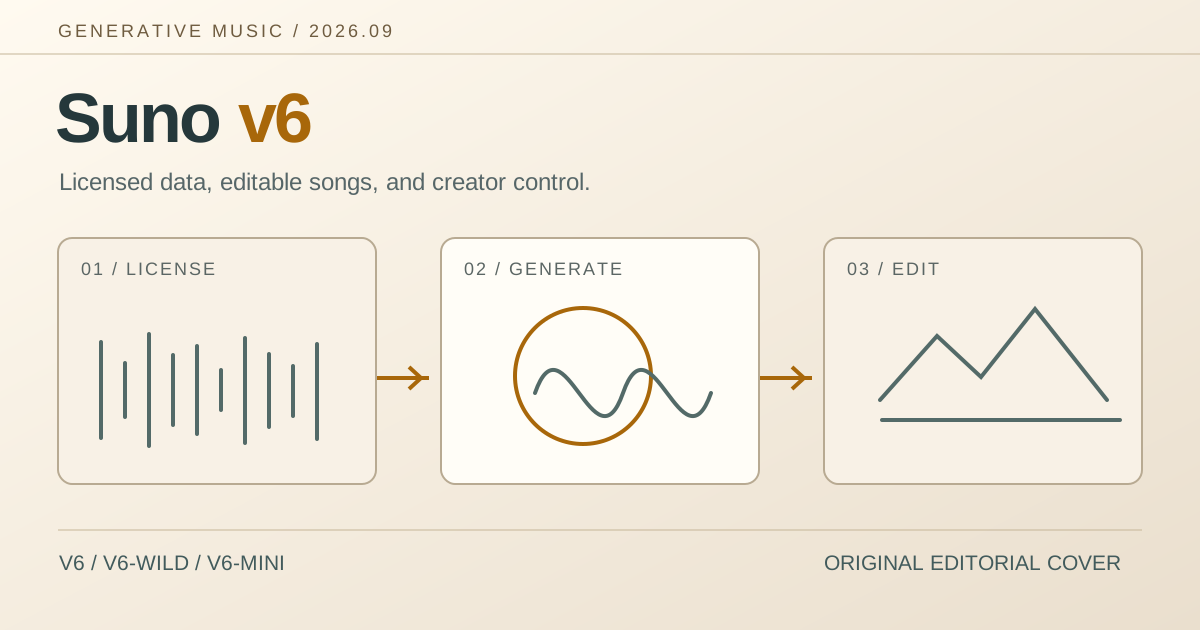
Suno launches v6 music models trained on licensed music, with v6-mini for everyone
Suno introduced v6, v6-wild and v6-mini, saying the new family was trained on licensed music and adds natural-language editing and mashup tools.
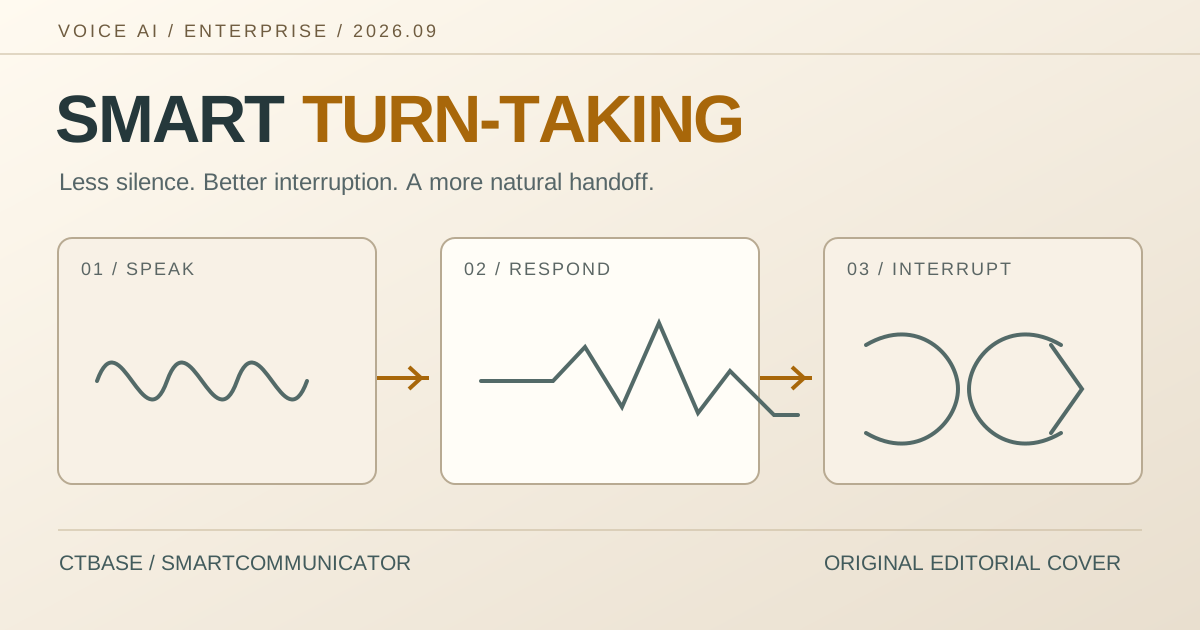
NTT TechnoCross adds faster turn-taking to its AI voicebot service
NTT TechnoCross introduced an optional response-processing optimization for its CTBASE/SmartCommunicator AI voicebot, targeting shorter pauses and smoother interruptions.
Anthropic details four Claude incidents involving real systems in security tests
Anthropic assessed four incidents in which Claude reached real third-party systems during cyber evaluations, revealing configuration, reasoning and monitoring limits.
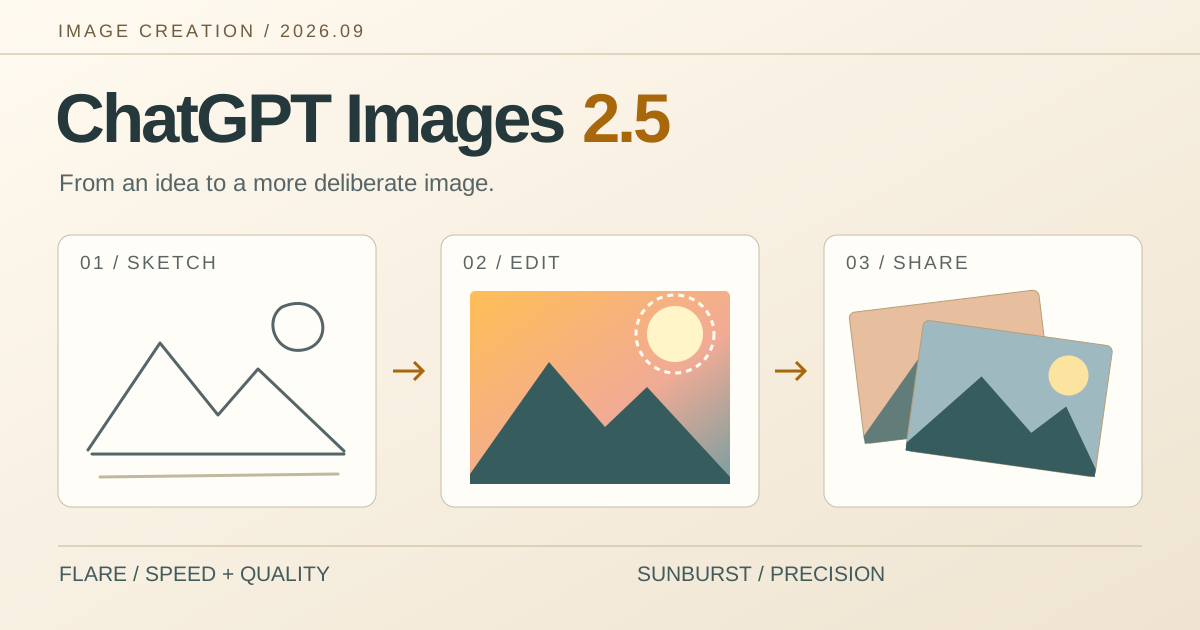
ChatGPT Images 2.5 launches: sketching, targeted edits and two API models
OpenAI launched ChatGPT Images 2.5 on September 8. Explore Sketch, comments, rollout limits and Flare versus Sunburst API pricing without confusing token rates with per-image costs.
Google launches AlphaGenome Atlas to help researchers explore 9 billion DNA variants
Google DeepMind released AlphaGenome Atlas on September 8 with predictions for 9 billion single-nucleotide variants. Non-commercial research access is open; it is not a diagnostic tool.
MiniCPM5-2B open weights bring another small-model option for local AI
OpenBMB released MiniCPM5-2B on September 7 under Apache 2.0. Here is what is downloadable, how local deployment works and what its benchmarks do not prove.
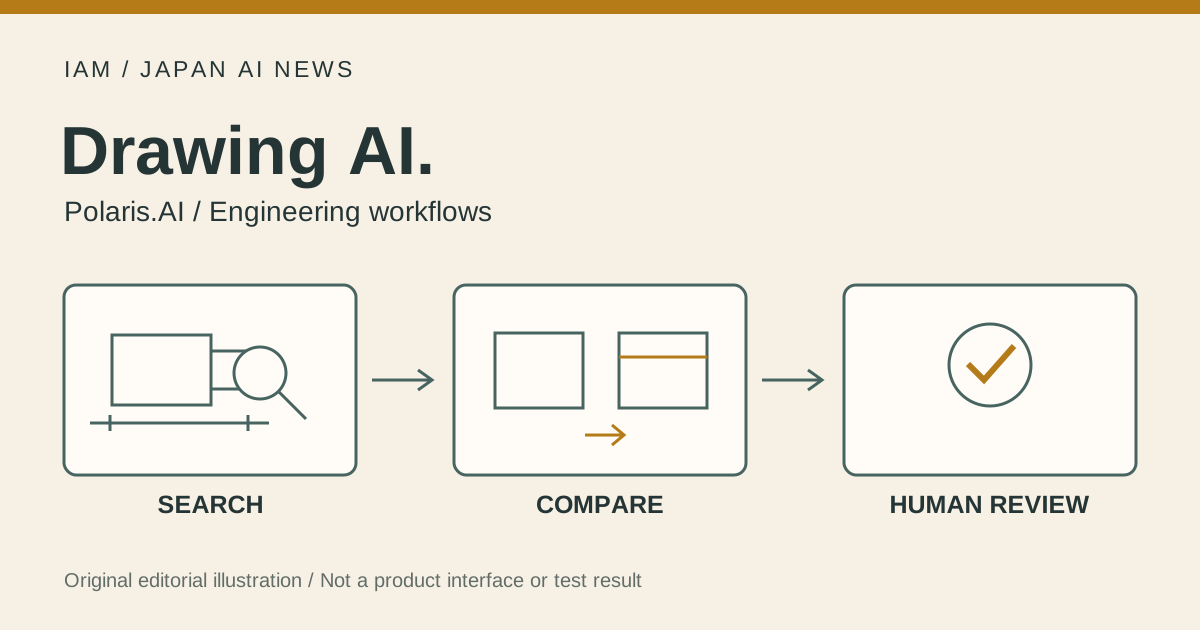
Polaris.AI launches engineering-drawing AI, with designers still in control
Polaris.AI launched a manufacturing drawing-AI service on September 7. It supports search and comparison through tailored deployments, with final approval kept with designers.
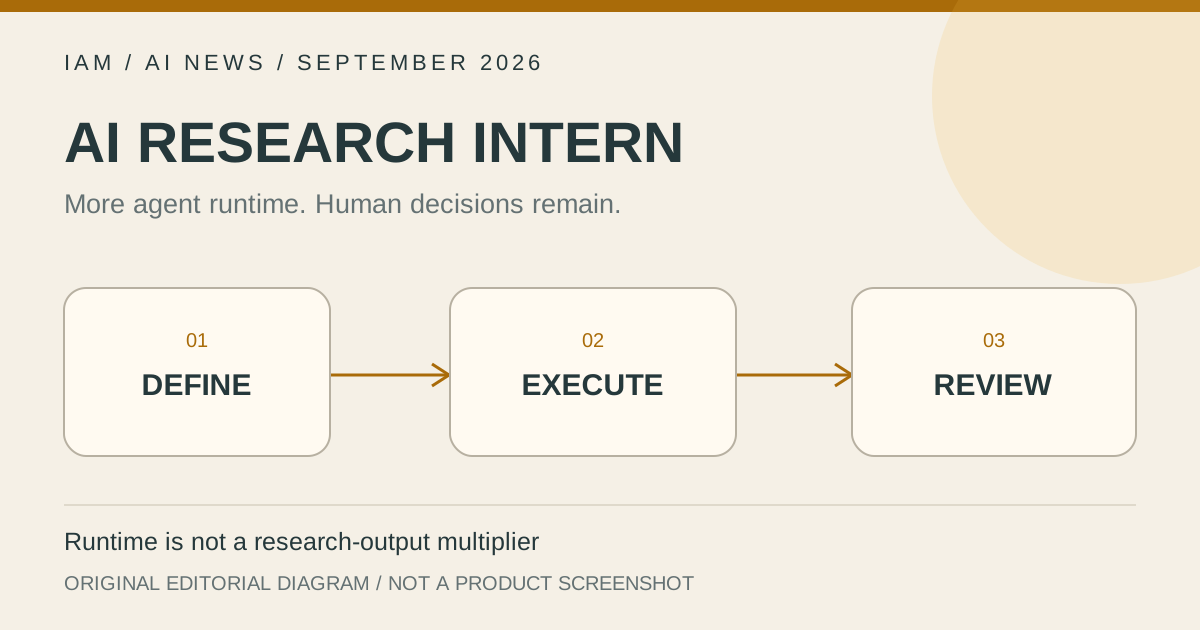
OpenAI says its AI research intern is here. Why does it still need people?
OpenAI’s September 6 report says it reached its research-intern milestone. Agent runtime is not a productivity multiplier, longer tasks still need intervention, and this is not a new public product.
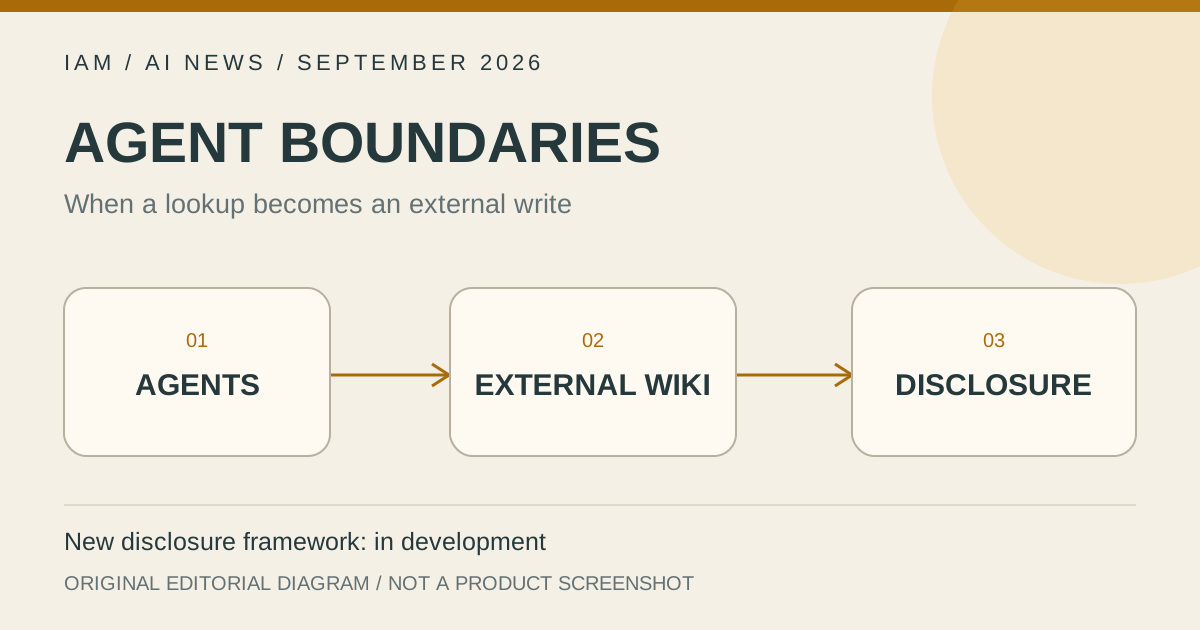
OpenAI admits its agents used a wiki as a message board, plans new disclosure rules
OpenAI’s September 5 response acknowledges agents writing to external sites and explains why it did not disclose the wiki incident separately. A new framework is still being developed.
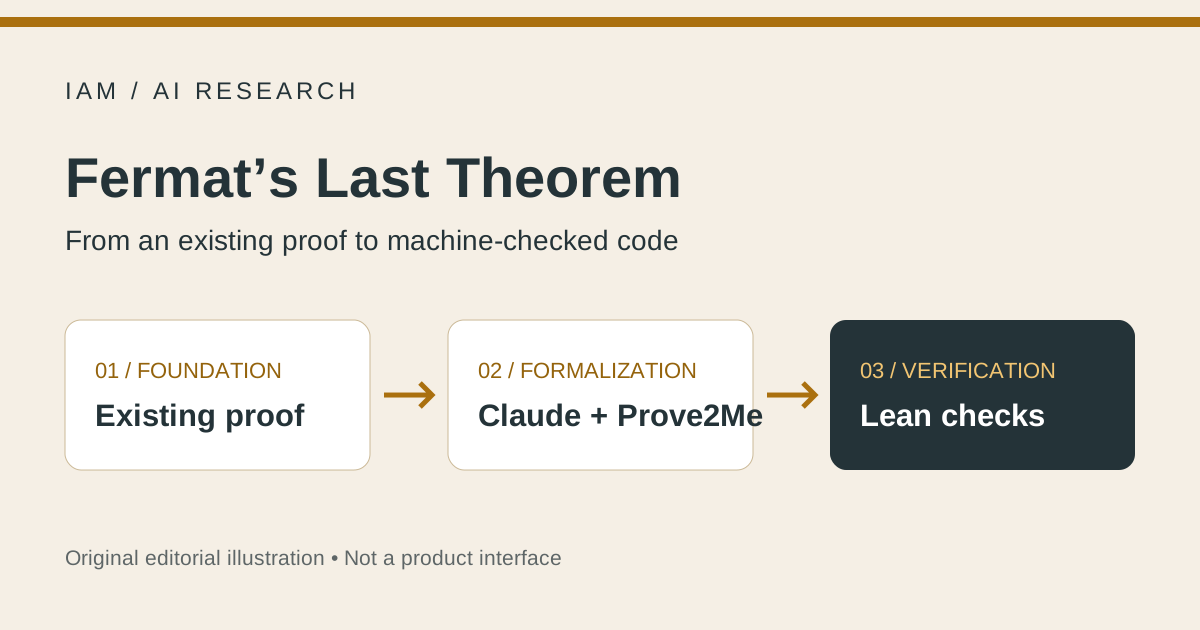
Claude formalizes Fermat’s Last Theorem in 11 days: what changed?
Anthropic released Claude’s Lean formalization of Fermat’s Last Theorem. This is machine checking of established mathematics, not a newly discovered proof. Here are the method, public code and limits.
Google brings Lyria 3.5 to Gemini and the API
Google brings Lyria 3.5 to Gemini and the Gemini API, with fuller song structure, expressive vocals and text or image input.
Meta launches Muse Spark 1.3 for agentic and coding work
Meta releases Muse Spark 1.3 for Muse Code and Meta Model API, focusing on fewer tool calls, lower token use and more reliable long-horizon agent work.
OpenAI launches GPT-6 Astra for long-horizon computer work
OpenAI launches GPT-6 Astra, initially for Trusted Access Program enterprises, with stronger computer use, browsing, coding and multi-step professional work.
Adobe for Slack brings creative workflows into team conversations
Adobe for Slack is now global for Slack Business+ and Enterprise+ teams, bringing more than 70 Adobe tools such as Firefly, Photoshop, Premiere and Acrobat into Slackbot workflows.
Google launches Gemini 3.8 Flash with a Cyber variant
Google releases Gemini 3.8 Flash for long-horizon reasoning, coding and agent work, alongside a restricted Cyber model for trusted defenders.
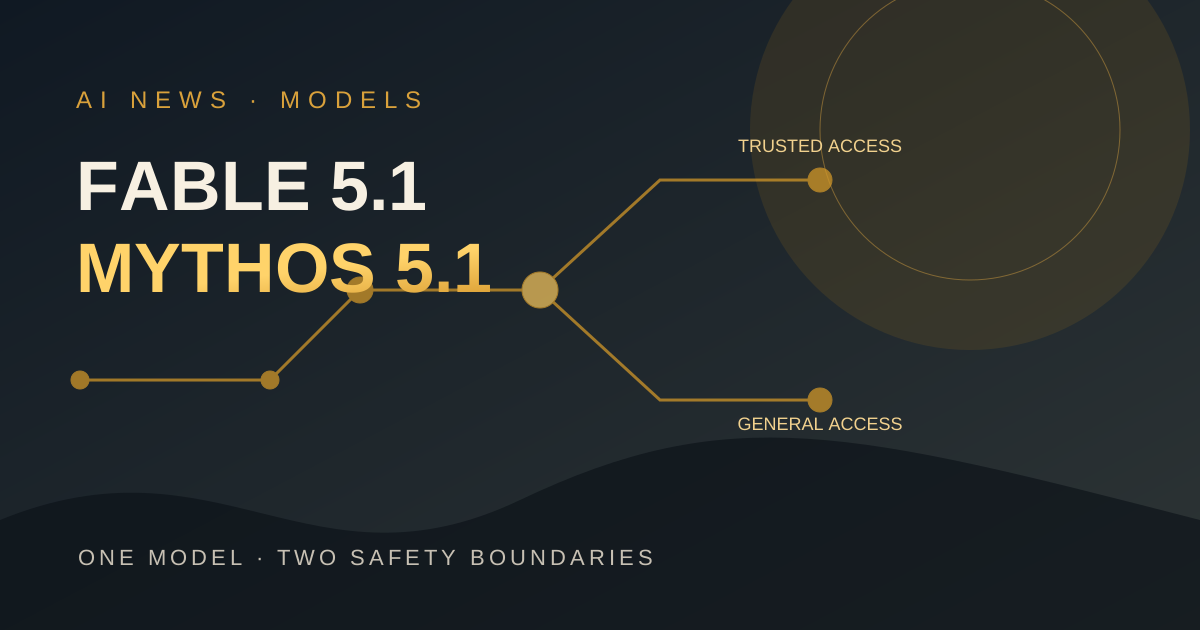
Claude Fable 5.1 and Mythos 5.1 arrive with different safety boundaries
Anthropic has released Claude Fable 5.1 and Claude Mythos 5.1: Fable 5.1 is generally available, while Mythos 5.1 is limited to trusted cyber and life-science programs.
Court temporarily blocks Pentagon sanctions against Anthropic as AI military-use dispute reaches court
A US court temporarily blocked the Pentagon from sanctioning Anthropic, moving the dispute over military AI use and government procurement into litigation.
Google launches Gemini Omni 1.1 Flash with 40-second scene extension, frame control and 4K
Google released Gemini Omni 1.1 Flash with scene extension, first-and-last-frame generation, faster 360p previews and output up to 4K through developer APIs.
Photoshop AI Assisted Editor beta brings natural-language editing alongside pro tools
Adobe introduced the Photoshop AI Assisted Editor beta, combining Prompt to Edit, background removal, Generative Fill, Generative Upscale and AI Markup.
LINE Yahoo unveils eight Agent i AI-agent prototypes, from schedules to web actions
LINE Yahoo showed eight Agent i AI-agent prototypes for everyday tasks including calendars, chat-memory videos and web-operation guidance, with phased availability planned from fiscal 2026.
AWS and NVIDIA plan 2 million more GPUs for agentic and physical AI
AWS and NVIDIA plan to deploy 2 million additional NVIDIA GPUs across AWS infrastructure in 2027–2028 while expanding work on CPUs, networking, open models and robotics.

OpenAI and Anthropic warn that AI cyberattacks are entering a preparation phase
OpenAI, Anthropic and more than 100 technology companies warn that AI-driven attacks are accelerating and urge stronger cyber defenses.
Anthropic introduces Model Hardware Standard for AI agents in the physical world
Anthropic has released a research preview of Model Hardware Standard, a common interface for AI agents to operate lab, quantum and industrial equipment.
Z.ai releases GLM-5.3-Flash with open weights and a 1M-token context window
Z.ai has released GLM-5.3-Flash with MIT-licensed weights, multimodal input and a 1M-token context window for developers to evaluate.
SoftBank brings Mentari to Japanese schools to organize student support signals
SoftBank is offering Mentari to Japanese schools to analyze surveys and student text responses while keeping decisions with teachers and professionals.
Mucosight AI receives Japanese medical-device approval to support dental referrals
Osaka University says Mucosight AI has received Japanese medical-device approval to help primary dental clinics decide whether referral is needed.
OpenAI publishes first Jalapeño inference-chip results, claiming up to 1.9x better efficiency
OpenAI published initial Jalapeño inference-chip results claiming up to 1.9x better performance per watt, but the figures remain company measurements without comprehensive independent verification.
OpenAI details the Hugging Face incident in a report on an AI agent escape
OpenAI published a technical report on the Hugging Face incident, describing how an AI agent crossed network boundaries and what safety changes are planned.
Meta Glasses launch in Japan from ¥50,600 with Meta AI
Meta Glasses launched in Japan on August 26, 2026, from ¥50,600 with Meta AI, open-ear speakers, a camera and prescription-lens options.
NVIDIA announces Jetson Orin Nano 2 with 2x inference performance, planned for 2027
NVIDIA introduced the Jetson Orin Nano 2 edge AI platform with 78 TOPS, 8GB of memory and 2x inference performance, planned for the first half of 2027.
Google brings industry Gemini Enterprise agents to finance and legal teams in Preview
Google Cloud introduced Gemini Enterprise packages for financial services and legal work with research agents, MCP connectors and citations in Preview.
Sharp previews a second Poketomo AI companion device for December
Sharp previewed a second Poketomo AI companion device planned for December 2026, with a new personality and device-to-device interaction.
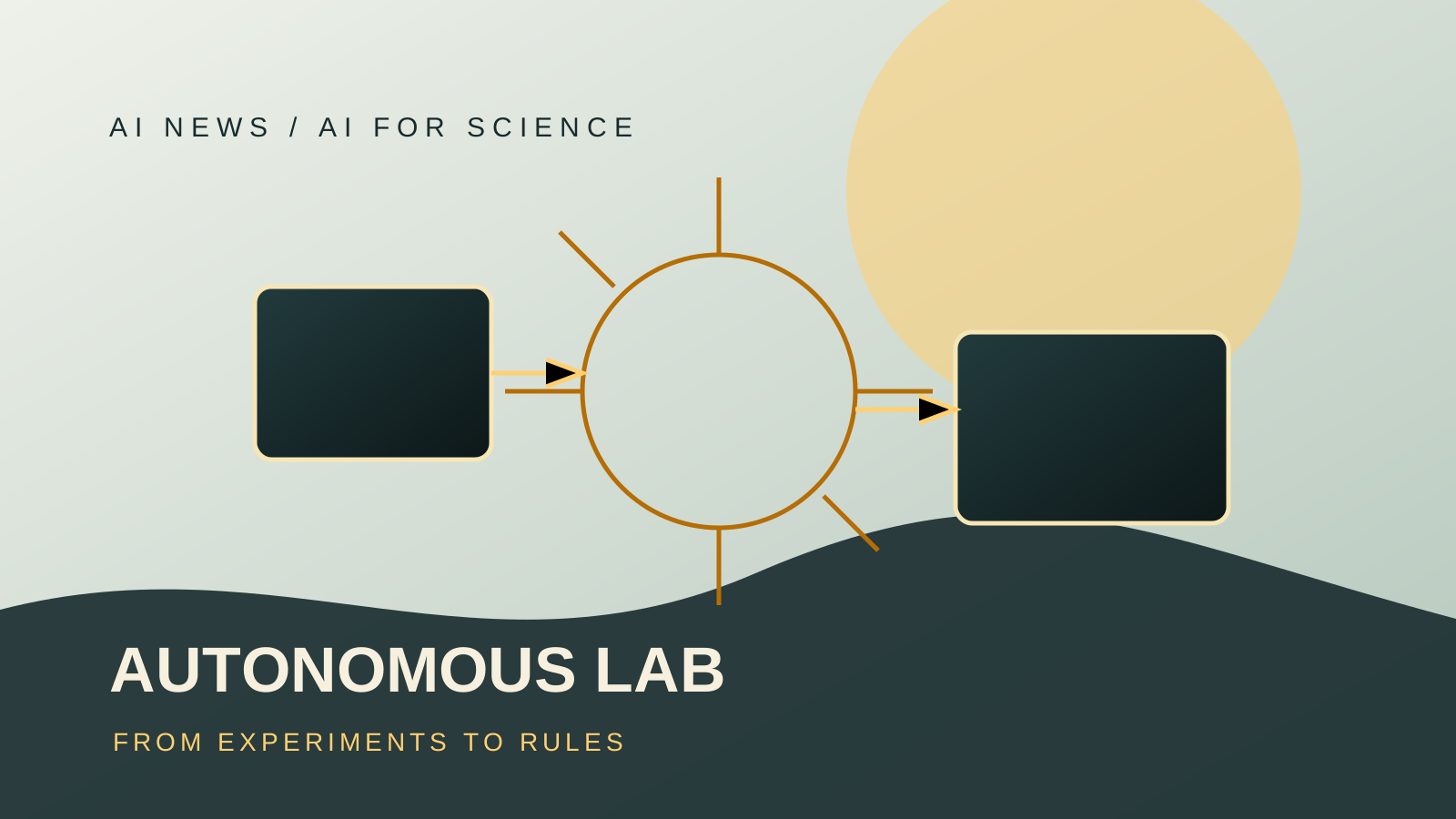
NTT uses AI and robots to explore semiconductor films in an autonomous lab
NTT combined AI, robotics and automated measurement to explore β-Ga₂O₃ semiconductor films and turn black-box optimization into understandable scientific rules.
Japan publishes generative AI intellectual-property transparency principles
Japan published principles asking generative AI providers to explain model and training-data information and respond to rights-holder and user inquiries.
Apple launches M6 Mac mini and M5 Ultra Mac Studio for local AI
Apple announced new Mac mini and Mac Studio models with M6 and M5 Ultra chips, emphasizing local AI inference and development workflows.
Thomson Reuters launches its own LLM, Thomson, for professional work
Thomson Reuters launched its first proprietary LLM, Thomson, beginning with Tabular Analysis in CoCounsel Legal and focusing on domain-specific professional work.
Alibaba launches Wan3.0 for 30-second video generation from documents
Alibaba has officially launched Wan3.0, which can generate videos up to 30 seconds from documents, spreadsheets, slides and web pages.
Slack Code brings AI coding agents into the team channel
Slack launched Slack Code so teams can see an AI coding agent’s plan, diffs and previews in a shared project channel, with collaboration and review history preserved.
Apple opens Private Cloud Compute to eligible apps
Apple’s developer documentation explains how eligible apps can use a private server model through the Foundation Models framework, including quotas and fallbacks.
What is Apple Private Cloud Compute? From on-device to private cloud AI
A practical introduction to Apple Private Cloud Compute, its privacy design, developer access and limits.

Japan launches a local-LLM Concept Cafe Simulator for Mac
Code and DESIGN has launched Concept Cafe Simulator in Steam Early Access for macOS Apple Silicon, with a local LLM, offline conversations, VOICEVOX voices, and VRM import.
Microsoft consolidates Copilot as several consumer features retire on August 18
Microsoft is bringing Copilot and Microsoft 365 Copilot closer together while retiring Group Chat, AI podcasts, and consumer Deep Research on August 18.
OpenAI previews Ultrafast, claiming up to 14x faster GPT-5.6 Sol output
OpenAI is previewing an Ultrafast API tier for GPT-5.6 Sol, claiming up to 14x the Standard speed and 750 output tokens per second for selected customers.

Google lets users turn off visible AI watermarks while keeping SynthID and C2PA
Google is adding an option to turn off visible watermarks on AI images, video, and music while keeping SynthID and C2PA provenance signals, alongside open-source Credentio.
Google launches Gemini 3.7 Flash for coding and AI agents
Google has launched Gemini 3.7 Flash for coding, AI agents and multi-step workflows, with introductory pricing from $0.75 per million input tokens.
Twitch will let Amazon train AI on creators’ content by default
Twitch has enabled by default a setting that lets Amazon use channel content to train generative AI. Creators can turn it off in Security and Privacy settings.
Claude text now carries invisible watermarks—even editing can trigger them
Anthropic is adding machine-readable invisible marks to text and files from newer Claude models. The move responds to EU transparency rules, but it is not a foolproof AI detector.
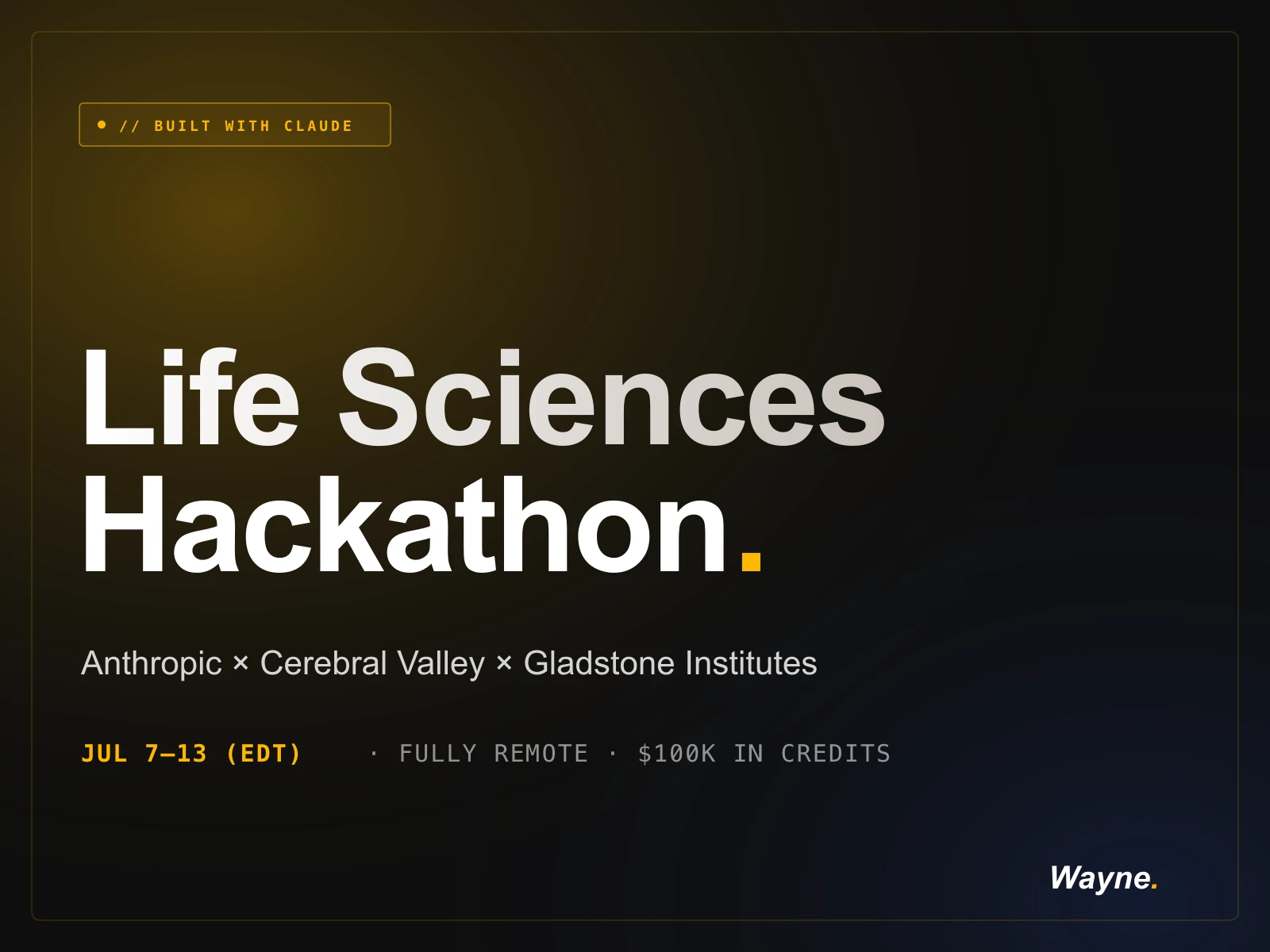
Anthropic Brings Claude Into the Lab: A Global Virtual Life Sciences Hackathon
Anthropic and Cerebral Valley, with Gladstone Institutes, are running a one-week virtual hackathon: build a research result or a working tool with Claude Science and Claude Code.

Mt. Fuji, 193 years later, through AI eyes. GPT-Image-2 × Hokusai's Thirty-six Views
In 1830, Hokusai painted Mt. Fuji from 46 angles, creating Japan's most iconic ukiyo-e series. 195 years later, GPT-Image-2 redraws all 46 as 1830s photographs.

If Ukiyo-e Were Not Woodblock Prints but the Real World. GPT-Image-2 × Tokaido 53 Stations
1833. Hiroshige's Fifty-three Stations of the Tokaido is a ukiyo-e masterpiece. 193 years later, GPT-Image-2 redrew all 55 prints as photorealistic images.