1830, Edo. Hokusai is seventy years old. He starts a series: views of Mt. Fuji from different places.
He planned 36 prints and titled the set Thirty-six Views of Mt. Fuji. They sold so well he added another ten. Forty-six in total. Fuji appears in every one, but never as the lead, always tucked behind a wave, a cherry tree, a snow drift, a roof, a bridge, a field, a well, a shop sign.
Printing wrapped in 1832. The series later landed on stamps, book covers, coffee mugs, skateboards, and shaped Van Gogh, Monet, Debussy. Print #21, The Great Wave off Kanagawa, became the single most recognised Japanese image worldwide. But at its core it is woodblock print: bold outlines, indigo ink, blocky colour, flat composition.
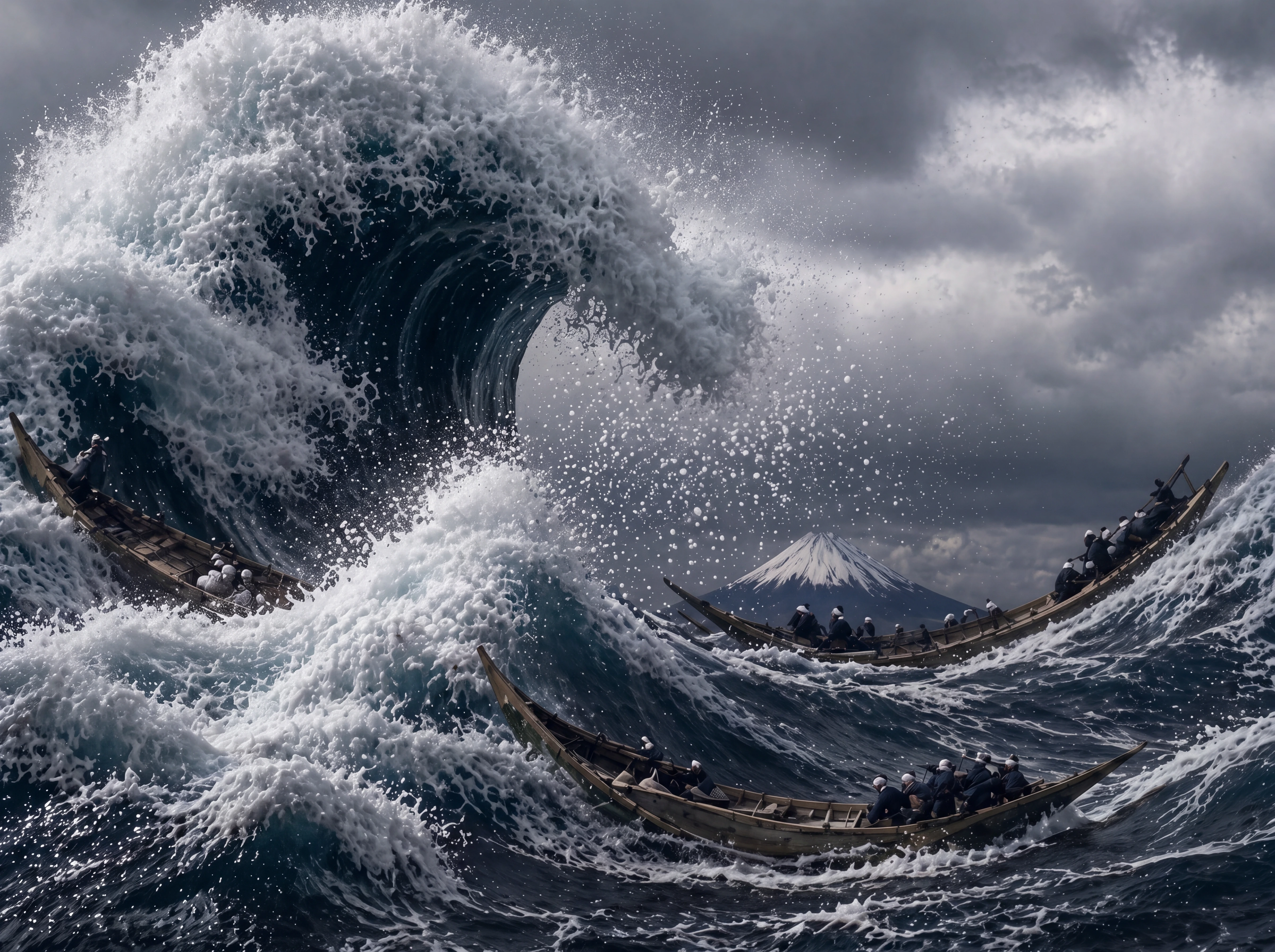
195 years later, in 2026, all 46 prints were redrawn using GPT-Image-2.
Not AI colourisation, not restoration, not super-resolution. Hokusai's composition, season, human motion, lighting intent are preserved entirely; only the visual style is swapped to a real-world photograph. As if a traveller hauling a large-format camera in the 1830s stood there and pressed the shutter while the wave crashed, while the well-worker bent over his task, while Fuji watched.
fitted with an 1830s lens.
Why Hokusai's Thirty-six Views
To the Japanese, Fuji has never been just a mountain. It is god, landmark, home, calendar. In the Edo era it was visible from nearly any high vantage on the Kanto plain, so every street, every bridge, every paddy quietly carried a distance and angle to the mountain.
Hokusai's motive was never to record the mountain itself (for that, 36 angles would be 33 too many; three would do). He recorded how Fuji lives inside everyday life. That is why across all 46 prints the mountain is never centred, always partly blocked by something closer: a wave, snow, cherry blossoms, roof tiles, smoke, people, horses.
Print #21, The Great Wave off Kanagawa, is this logic at its peak. Fuji is almost swallowed by a giant wave, and yet stands out more sharply there than in any of the other prints. That is Hokusai's genius.
The series came out between 1830 and 1832. Hokusai was already in his seventies, signing as Iitsu and Manji. It became the best-selling ukiyo-e in Edo overnight and cemented his legend as the Old Man Mad About Drawing.
How the prompt was written
As simple as the Tokaido piece. Hand the original print to GPT-Image-2 as a reference image, add one sentence about the look.
Core rule: preserve composition, Fuji's position, figures, season and light direction; only swap the visual style. The model fills in physical details the print never had — spray, snow reflections, layered mist — without bending Hokusai's framing.
Forty-six prints, one identical prompt, only the reference image swapped each time. Here is the result.
46 versions of 1830.
Full set · 46 prints
From Edo Nihonbashi out through Kai, Shinano, Suruga, Izu, Sagami and Awa. Arranged in the commonly used numbering. Click any print for full size.