Year 1833, Edo. Utagawa Hiroshige painted The Fifty-three Stations of the Tokaido.
A 514-kilometer road from Nihonbashi to Sanjo Ohashi in Kyoto, with 53 post stations along the way. One print per station. With the start and end points, 55 prints total.
This is one of the most famous ukiyo-e series. Later printed on stamps, postcards, kimonos, senbei tin lids, influencing Van Gogh, Monet, Whistler. But its core was always woodblock printing: flat lines, blocked color, one wood plate per pigment.
193 years later, in 2026, all 55 prints were redrawn using GPT-Image-2.
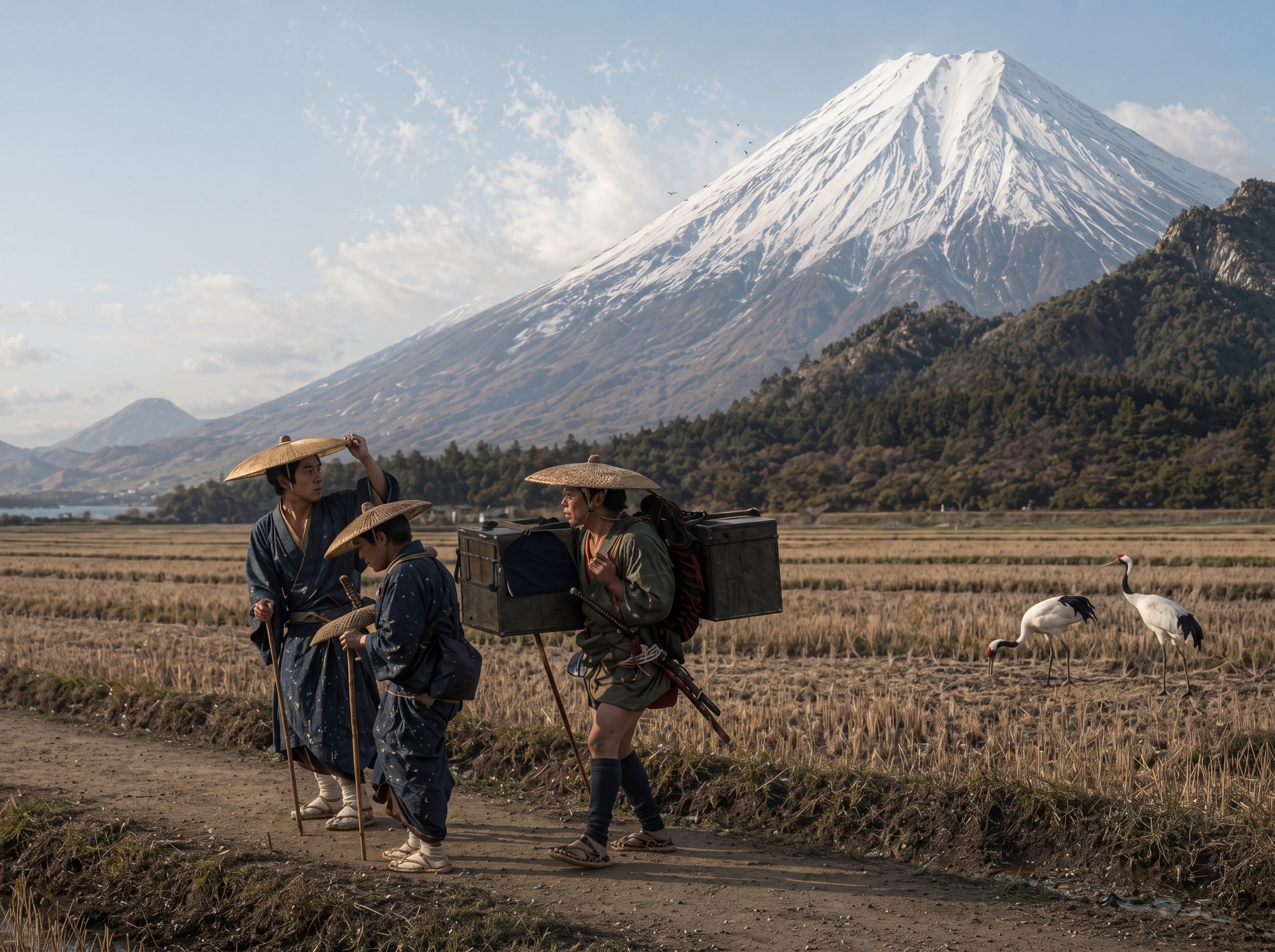
Not AI colorization. Not photo retouching. Not super-resolution. The composition, season, gestures, and light intent of Hiroshige are preserved entirely, but rendered as a real-world photograph. As if someone in 1833 had stood there at dawn with a camera in Kanbara's snow, in Mishima's morning fog, watching the ferry leaving Kawasaki, and pressed the shutter.
but new eyes to
look at the classics again.
Why The Tokaido 53
The Tokaido was the most important highway of Edo Japan. After Tokugawa Ieyasu made Edo his capital, the Five Routes system was established; the Tokaido was the first of the five, linking the political center Edo with the imperial seat in Kyoto.
Every 7-10 km, a shukuba (post station) was set: places for daimyo processions on sankin-kotai duty, merchants, pilgrims, and wandering ronin to swap horses, lodge, eat, and relay official documents. Like beads on a string, 53 stations threaded the entire road.
In 1832 Hiroshige walked the entire road accompanying a shogunate delegation. Returning to Edo, he drew the series from his sketches. Published 1833-1834 by Hoeido, it became an instant bestseller.
Its value isn't documentary accuracy (Hiroshige freely rearranged terrain, season, and place), but in turning "the journey" into an aesthetic: rain in Shono, the river crossing at Kanaya, snow night in Kanbara, cherry blossoms over Ejiri. These scenes became the Japanese collective memory of "being on the road."
How to Write the Prompt
It's actually simple: hand the original print to GPT-Image-2 as a reference image, and add one sentence describing the target style.
One core rule: preserve composition, characters, season, and light direction; only swap the visual style. The model fills in physical details absent in the original (snow reflections, lantern glow, footprints in the snow), but never breaks the composition.
All 55 prints use the same single-sentence prompt; only the reference image is swapped for each station. Here is the result:
swap in an 1830s lens.
All 55 Stations
From Nihonbashi to Sanjo Ohashi, station by station. Click any image to enlarge.