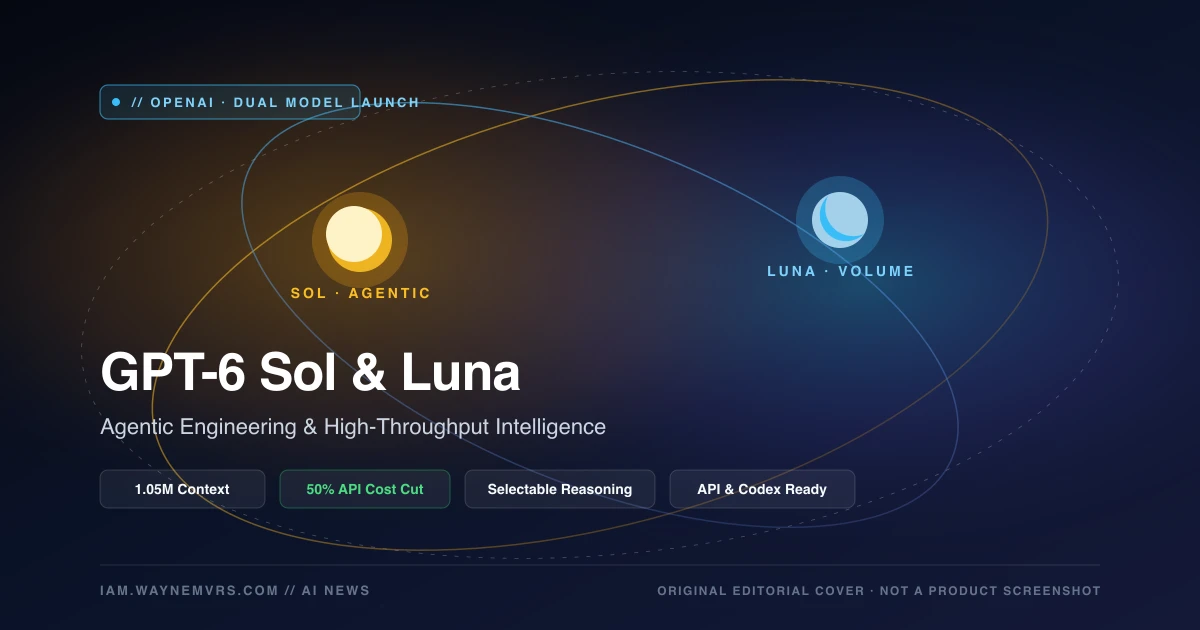
OpenAI announced GPT-6 Sol and GPT-6 Luna on September 22, 2026, expanding the GPT-6 model family alongside the flagship GPT-6 Astra. The two new models emphasize cost efficiency and specialized workloads: Sol is tailored for complex agentic workflows and software engineering, while Luna is optimized for high-volume summarization and data extraction. Both models feature a 50% price reduction for API usage compared to their predecessors, alongside a 1.05M-token context window and selectable reasoning effort.
Model Positioning and Dual-Tier Strategy
OpenAI officially introduced two new members of the GPT-6 family on September 22, 2026: GPT-6 Sol and GPT-6 Luna. Following the early September debut of flagship GPT-6 Astra for deep reasoning and long-horizon computer use, OpenAI released these models to provide enterprises and developers with more cost-predictable and workload-targeted options.
Sol is positioned as a mid-priced workhorse optimized for software engineering, complex debugging, automated agentic pipelines, and professional analysis. Luna focuses on large-scale, high-throughput routine tasks such as bulk summarization, structured data extraction, classification, and customer workflow routing.
Core Specs and 50% Price Reduction
Both models support an expansive 1,050,000-token context window and up to 128,000 maximum output tokens. Additionally, both feature selectable reasoning effort levels (none, low, medium, high, xhigh, max), enabling developers to balance response latency and deliberation depth according to task requirements.
For API pricing, both models represent a 50% cost cut compared to their predecessor generation. GPT-6 Sol costs $2.00 per million input tokens and $10.00 per million output tokens, while GPT-6 Luna costs $0.10 per million input tokens and $0.50 per million output tokens. OpenAI confirmed these figures as permanent baseline rates, lowering operational hurdles for production agents.
Platform Support and Availability
On launch day, GPT-6 Sol and Luna arrived simultaneously on the OpenAI API under the model IDs gpt-6-sol and gpt-6-luna. Both models fully support Responses API tools, including web search, file search, image generation, code interpreter, and function calling.
In end-user applications, both models are rolling out to ChatGPT Work and Codex for Plus, Pro, Business, Enterprise, and Edu subscribers. This allows developers and knowledge workers to leverage the new architectures directly within their IDEs and collaborative workspaces for faster coding and documentation.
Industry Implications and Evaluation Takeaways
This release reflects a pragmatic shift among frontier AI labs: moving from purely pursuing raw benchmark frontiers to crafting practical tiered matrices balancing cost, latency, and workload scope. Flagship Astra tackles cutting-edge problems, Sol powers daily engineering and agent scheduling, and Luna handles massive batch workloads.
For engineering leaders, the focal point is establishing clear model routing rather than defaulting to the largest model. Delegating high-volume jobs to Luna, routing compound workflows to Sol, and reserving Astra for critical decisions enables teams to significantly cut inference budgets without sacrificing output quality.