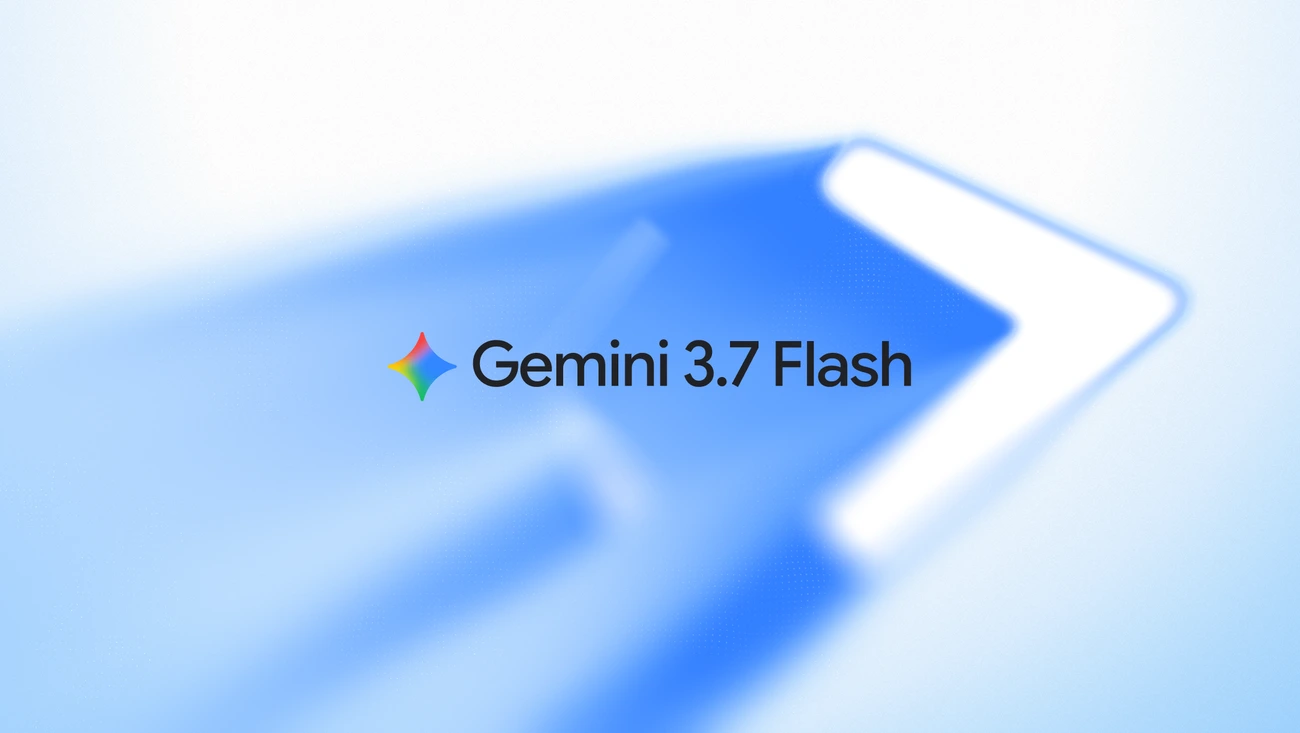
Google announced Gemini 3.7 Flash on August 13, 2026. It arrives about three weeks after Gemini 3.6 Flash and is described as the company’s most intelligent workhorse model yet. The focus is software engineering, knowledge work and AI agents, not just faster chat replies.
This is more than a speed upgrade
The core change is moving the Flash series from “answer quickly” toward “keep executing the work.” Google says it improved debugging, issue resolution, long-horizon software engineering and web generation from designs, with the goal of reducing detours and retries in agent loops.
It supports three thinking levels — low, medium and high — so developers can trade off latency, cost and reasoning depth by task. It also keeps a context window of up to 1M tokens and a maximum output of 64K tokens.
Pricing and availability
The API model ID is gemini-3.7-flash. It is available through Google AI Studio, the Gemini API, Google Antigravity, Android Studio and Gemini Enterprise Agent Platform. Google’s developer documentation marks it GA and ready for production use.
Introductory pricing runs through December 31, 2026: $0.75 per million input tokens and $3.75 per million output tokens. From January 1, 2027, the prices become $1.50 and $7.50. Google says the same introductory rate will also apply to 3.6 Flash.
Google’s published benchmark results
Google’s comparison shows the main gains over 3.6 Flash in coding, long-horizon agent tasks, web development and enterprise workflows:
- FrontierCode 1.1: 43.6%, compared with 34.4% for the previous model.
- DeepSWE v1.1: 65.3%, compared with 49.0% for the previous model.
- WebDev Arena: Elo 1588 versus 1538; AutomationBench: 30.4% versus 17.0%.
These are results published by Google and are useful for understanding the product’s positioning. They do not mean every project or prompt will see the same improvement. Teams should still measure whether their own tasks require fewer retries and less manual review.
Who will notice the difference?
If your work involves repeatedly reading code, fixing bugs, calling tools, processing long documents or building UI from screenshots and design systems, 3.7 Flash has a clear target: a multi-turn work partner rather than a chatbot that only completes one sentence.
For product teams, the lower introductory price makes it easier to route most steps to a fast model and send only the hardest problems to a larger one. But lower cost does not remove the need for permissions, tests and human review; the more tools an agent can use, the more important its verification boundaries become.
Limitations to know before using it
Google DeepMind’s model card still lists common foundation-model limitations, including hallucinations and occasional slowness or timeouts. The knowledge cutoff is March 2026, while some domains may only be current to January 2025, so current news, prices and policies still need separate verification.
Being “better for agents” describes the product direction; it does not mean the model can complete every long process without supervision. The practical questions are whether it makes fewer mistakes and retries in a real codebase, and whether it pauses to ask when it is uncertain.
For the launch overview, see Google’s official announcement. For full specifications, see the Gemini 3.7 Flash guide from Google AI for Developers and the Google DeepMind model card.
The point of Gemini 3.7 Flash is not that Google added another version number. It is that the Flash series is now targeting the AI workflows that run at scale every day. If coding, agent tool calls and cost matter to you, it is worth testing; if you are waiting for an update in the free Gemini chat interface, check your region and plan first.